Color Outside the Lines: A Fresh Look at Leslie Crayon
There is a specific kind of nostalgia that hits you when you peel back the wrapper on a fresh box of crayons. It’s that mix of waxy scent and the promise of a blank sheet of paper, a feeling of pure, uninhibited potential. Capturing that feeling in a digital design is notoriously difficult, yet it is exactly what the Leslie Crayon display typeface manages to achieve. For designers, brand strategists, and small business owners looking to inject a "youthful-and-yearning" soul into their visual identity, this font offers more than just letterforms; it offers a mood. It is a premium font choice that bridges the gap between professional typography and the raw, charming texture of hand-drawn art.
The Texture of Authenticity
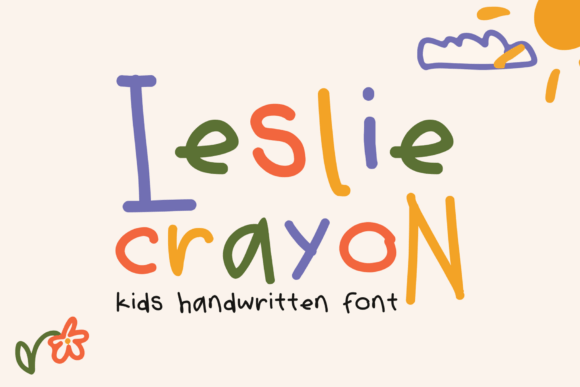
What separates a standard display font from a truly immersive handwritten font like Leslie Crayon? It comes down to the details of the stroke. Digital typography often suffers from sterile perfection—every curve is mathematically precise, and every terminal is sharp. Leslie Crayon subverts this by embracing the imperfections of a real crayon stroke. The letterforms feature a rhythmic, waxy texture that mimics the friction of pigment on rough paper. You can see the light structural weight in the characters, giving them a delicate, airy quality that feels innocent rather than heavy.
The soft, uneven terminals are particularly effective. In modern typography, sharpness is often equated with professionalism, but in the world of independent branding—specifically for family-oriented or creative industries—sharpness can feel cold. Leslie Crayon’s rounded, slightly jagged edges evoke the pure joy of childhood creativity. This makes it a standout choice for anyone working in the creative space, whether you are a hobbyist designing a family scrapbook or a professional creating packaging design for a new toy line. It signals to the viewer that the brand is approachable, tactile, and human.
Applying Leslie Crayon in Real-World Branding
Understanding the personality of a creative font is one thing; applying it effectively is another. Because Leslie Crayon carries such a strong "playful-and-primary" vibe, it requires thoughtful placement to maximize its impact without overwhelming the viewer. Here is how different professionals can leverage this typeface across various design assets.
For Independent Toy Branding and Packaging
If you are launching a line of wooden toys, organic crayons, or educational kits, your brand identity needs to scream "fun" without looking cheap. Leslie Crayon is the premier choice here. Use it for the primary logo or the main headers on your packaging. The waxy texture mimics the product itself, creating a cohesive visual loop. Pair it with kraft paper textures or matte finishes to enhance that tactile feeling. When a parent picks up the box, the typography should feel as safe and delightful as the toy inside.
Children’s Books and Editorial Design
In editorial design, specifically for children’s book illustrations or nursery decor prints, readability is key, but atmosphere is paramount. Leslie Crayon works beautifully for chapter titles, pull quotes, or the author's name on the cover. It avoids the rigidity of standard sans serif fonts, allowing the text to sit comfortably alongside hand-drawn illustrations. It bridges the gap between the image and the text, ensuring the typography doesn't look like an afterthought pasted on top of the artwork.
Social Media and Digital Marketing
The digital landscape is crowded. To stop the scroll, you need social media graphics that feel distinct. Leslie Crayon is perfect for high-impact headers on Instagram stories, Pinterest pins, or Facebook banners for parenting blogs and lifestyle influencers. Its light weight ensures that even on small mobile screens, the text remains legible while maintaining its whimsical charm. It is an excellent tool for web design headers where you want to convey a sense of creativity or DIY spirit without sacrificing load times or clarity.
The Art of Font Pairing and Hierarchy
One of the most common questions in typography is how to handle font pairing. A display typeface like Leslie Crayon is bold in personality, which means it needs a grounding partner. You rarely want to use a textured, handwritten font for long blocks of body copy, as it can tire the reader's eyes.
Instead, treat Leslie Crayon as your "headline hero." Use it for H1 and H2 tags, logos, and call-to-action buttons. For the body text, you need a workhorse. A clean, geometric sans serif font often pairs best here. The neutrality of the sans serif will allow the crayon texture to pop without competing for attention. Alternatively, if you are going for a more vintage or storybook aesthetic, a sturdy serif font with low contrast can provide a nice structural counterpoint to the whimsical nature of the crayon strokes.
When testing your pairings, pay close attention to scale. Leslie Crayon has distinct details that get lost if the font size is too small. Ensure that wherever you use it, the "waxy texture" is visible. If you shrink it down to 12pt for a footer note, it might just look like a blurry line rather than a charming stroke. Always design for the medium; what works on a large format poster might not work for fine print on an invitation.
Practical Considerations for Commercial Use
For designers and business owners, the aesthetic appeal of a font is only half the equation. The practical application and licensing are equally important. When investing in a premium font like Leslie Crayon, you are paying for quality and versatility.
- Reviewing Font Styles: Before purchasing, check what is included in the family. Does it have alternates? Are there multiple weights? For a font like Leslie Crayon, stylistic alternates are a massive bonus. They allow you to swap out specific letters to avoid repetition in words like "balloon" or "hello," making the text look even more organic and less digital.
- Commercial Licensing: If you are using this font for a client project, merchandise (like t-shirts or mugs), or print-on-demand products, you must ensure your license covers commercial use. Most foundries offer different tiers for desktop, web, and app usage. Read the fine print to avoid legal headaches down the road.
- Readability vs. Vibe: Always test your text with your target audience. What looks "artistic" to a designer might be unreadable to a consumer. Use Leslie Crayon for impact, but rely on standard typography for essential information like ingredients, instructions, or disclaimers.
Capturing the "Youthful-and-Yearning" Spirit
Ultimately, the goal of using a typeface like Leslie Crayon is to evoke an emotion. It’s about tapping into that yearning for simpler times, for the tactile joy of making something by hand. In a world of vector-perfect, sterile interfaces, this handwritten font offers a breath of fresh air. It tells your audience that you value creativity, that you embrace imperfection, and that you are not afraid to color outside the lines.
Whether you are designing a logo for a new daycare center, crafting a header for a parenting blog, or packaging a line of artisanal goods, Leslie Crayon provides the visual language of joy. It reminds us that design doesn't always have to be serious; sometimes, it just needs to be fun. By integrating this typeface into your toolkit, you are not just choosing a font; you are choosing a personality that resonates with the inner child in all of us.